
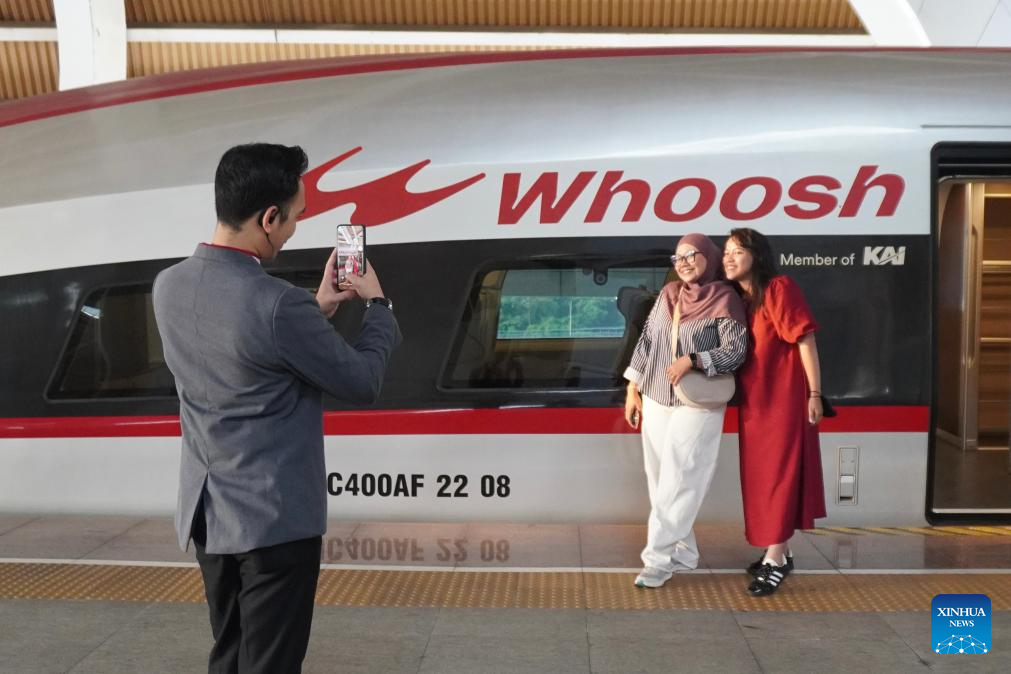
Passengers pose for photos with a train of the Jakarta-Bandung High-Speed Railway on the platform of Halim Station in Jakarta, Indonesia on June 2, 2026.(Xinhua/Zhang Yisheng)
by Xinhua writers Cao Kai, Zhang Yisheng
BANDUNG, Indonesia, June 7 (Xinhua) -- Outside a high-speed train station in Bandung, Indonesia's fourth-largest city, Ricky, a 29-year-old ride-hailing driver, waited in line to pick up his next passengers.
"I come here many times a day to pick up and drop off passengers," he told Xinhua, noting that the Jakarta-Bandung High-Speed Railway, locally known as "Whoosh," has made Bandung easily accessible from Jakarta, located just 150 km away.
Official data showed that as of June 4, the landmark railway, the first overseas high-speed railway project that fully uses Chinese railway systems, technology and industrial components, has handled over 15.88 million passenger trips.
Yet, Bandung offers far more than just the thrill of modern speed. For many, the city's truest significance dates back to a momentous gathering 71 years ago.
Standing on Bandung's bustling Asia-Africa street, colonial-era buildings stand in quiet dignity under the tropical sun. One's thoughts could easily drift back through time to that spring of 1955, when representatives from 29 Asian and African nations gathered here for the historic Bandung Conference.
Back then, tens of thousands of local people lined the streets in eager anticipation as leaders walked proudly together, opening a new chapter of solidarity and mutual support.
Gedung Merdeka, situated right on the street, is a three-story, cream-colored landmark. In its colonial past, the building was an exclusive social club for elites. In 1955, it took on a monumentally different role as the venue for the landmark conference. In 1980, its east wing was dedicated as the Museum of the Asian-African Conference, forever preserving that epochal chapter of history.
Though it was still ahead of the museum's opening hours, Elvitarizky, a mother from Indonesia's second-largest city of Surabaya on the northeastern coast of Java, was already waiting outside with her two children.
"I brought them here specifically so they could see and feel the Bandung Spirit firsthand," she said. "I want them to truly understand what peace and cooperation mean."
Inside the exhibition halls, precious historical images and artifacts weave a tapestry of the past. Within just an hour of browsing, a Xinhua reporter crossed paths with three energetic study groups.
One 50-strong group had traveled all the way from a nearby junior high school. "We brought the young students here to remember history and honor our predecessors," their teacher said. "History is the ultimate textbook."
Just a stone's throw away, on the opposite side of the street, sits the Savoy Homann Hotel, where the delegates stayed during the historic conference.
In the hotel lobby hangs a colonial-era map of Java, prompting a somber reflection on the turbulent past of the archipelago. Back then, networks of old railways crisscrossed the island, siphoning spices, rubber, and minerals away to the ports of colonial masters.
Straddling the equator, Indonesia has always been blessed with natural abundance. Wang Dayuan, a 14th-century Chinese navigator and explorer, praised Java's fertile soil and flat plains in his accounts, noting they yielded grain and rice in such abundance that it doubled that of other nations. Italian explorer Marco Polo also marveled at the region's thriving commerce in his journal.
However, such immense wealth invariably invited boundless greed. From the 17th century onward, the warships and cannons of Western powers shattered the region's tranquility. As writer Elizabeth Pisani observed in "Indonesia Etc.: Exploring the Improbable Nation," colonialists were interested in making money and cared little for the welfare of the locals. For a long period, Indonesia was exploited as a primary source of overseas wealth for the Netherlands.
Yet, facing ruthless oppression, the Indonesian people fought back valiantly, generation after generation, until the dawn of national independence finally broke in 1945.
Today, the baton of history has been passed to a new generation. At a recent international seminar commemorating the 71st anniversary of the Asian-African Conference, the Bandung Spirit of solidarity, friendship and cooperation remained the most frequently invoked concept among participants.
Al Busyra Basnur, president of the Indonesia-China Friendship Association, just concluded a 10-day visit to China in late May, where he attended multiple events aimed at promoting exchange and communication between the two nations.
"In recent years, deepening cooperation and mutual support between Indonesia and China within multilateral frameworks have powerfully driven regional prosperity and development," Basnur told Xinhua.
Amity between the people holds the key to sound state-to-state relations, a remark deeply shared by Kang Zhenguo, Chinese director of the Confucius Institute at Maranatha Christian University in Bandung.
Kang told Xinhua that the long-standing friendship between the two peoples relies heavily on the younger generation staying connected. In recent years, flagship cooperative projects like Whoosh have brought tangible convenience to locals and brought the two sides closer together.
"Today, more and more young Indonesians are enthusiastic about learning Chinese, fascinated by Chinese culture, and eager to study in China," Kang said. "We hope to hold more cultural activities to build bridges of mutual understanding while ensuring the Bandung Spirit continues to echo in the hearts of the youth." ■

This photo taken on June 3, 2026 shows an exterior view of Gedung Merdeka, the venue of the historic Asian-African Conference, in Bandung, Indonesia.(Xinhua/Zhang Yisheng)